Having gone from the height of success with the F4U Corsair to the unimpressive F6U Pirate and the unpopular F7U Cutlass, Vought finally scored a postwar victory with the F8U Crusader, the first purpose designed carrier jet fighter that was really technically competitive with its land based contemporaries.
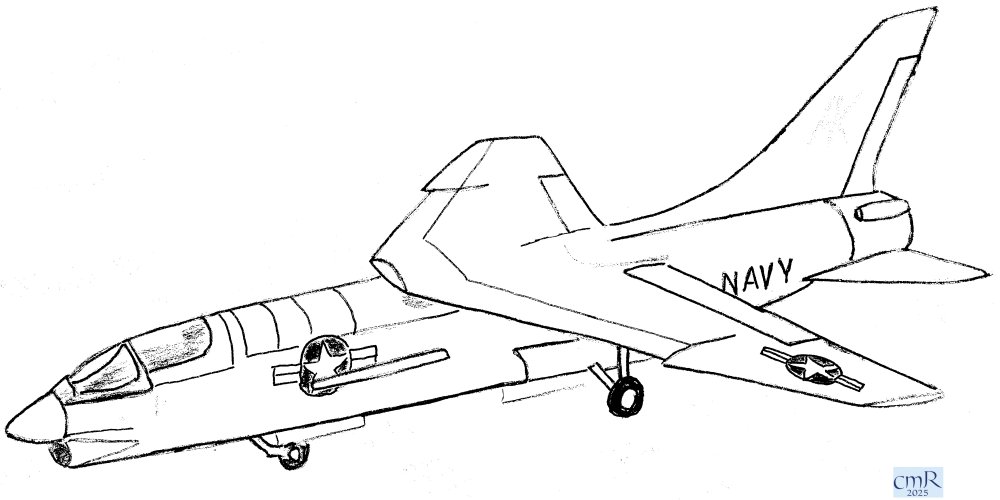
The F4U and F7U-1 had suffered from poor pilot visibility on carrier landings, and no doubt with this in mind from the start, Vought's designers incorporated on the Crusader a two-position wing that would allow the aircraft's angle of attack to be increased without the nose having to be raised. The F8U's armament was initially comprised of a quartet of 20mm cannon and an (almost useless, and occasionally dangerous) retractable launcher on the lower fuselage for 2.75" unguided rockets.
Variants: F8U-1/F-8A: The first F8U-1s entered fleet service with VF-32 in the spring of 1957. As potent as the Crusader was, it was also something of handful, especially for pilots operating from the smaller SCB-27 ships, and losses throughout the aircraft's service life were high.
F8U-1D/DF-8A: Drone director conversions.
F8U-2/F-8C: J57-P-16 engine and ventral fin installation.
F8U-2N/F-8D: Capable of carrying four AIM-9s; J57-P-20 engine.
F8U-2NE/F-8E: Last new-build US version, with the capability of carrying underwing AGM-12s or bombs in the fighter-bomber role; J57-P-20A engine.
F-8E(FN): The only foreign customer for new-build Crusaders, and ultimately the last bastion of the type, France's Aeronavale chose the F-8 in 1963 to replace its long obsolete Aquilons. The Crusader itself was not on the cutting edge by that time, but the French needed an aircraft sized for regular operations from the Clemenceau class carriers, for which the F-4 would not be ideal. Even then, fairly extensive alterations had to be made to the F-8 to allow slower landing speeds, including BLC, increased droop for the ailerons and flaps, and larger horizontal tailplanes. By the late 1980s, the Crusader's effectiveness as a front line fighter was a thing of the past for the most part, although it was still effective in a close-in fight. Arrival of naval Rafales was still a way off, and many were advocating procurement of FA-18s as an interim measure. This was political non-starter, and the Aeronavale was forced to put 17 Crusaders through a limited upgrade program to keep them operating till the turn of the century. The resulting F-8Ps had the Sherlock RWR system (but no countermeasures fitted) rehabbed radar and electrical systems, and zero-zero ejection seats.
F-8J: Remanufactured F-8Es.
F-8K: Remanufacture of 87 F-8Cs.
F-8L: Remanufacture of 61 F-8Bs.
F-8P: 25 ex-USN F-8Hs refurbished for the Philippines; an additional ten aircraft were transferred for spares.
At War: The F-8 was involved from early on in the American combat involvement in Vietnam, with four Crusaders from the USS Ticonderoga strafing North Vietnamese torpedo boats during the first Gulf of Tonkin incident in August 1964. By the spring of the following year, US and NVAF aircraft had begun to duel, with an initial encounter between Hancock-based Crusaders and North Vietnamese MiG-17s resulting in damage to an F-8. The first Crusader victory was scored in June 1966 - the first of three MiGs that VF-211 claimed that month. In all, by 1972 Crusader pilots claimed 16 MiG-17 and three MiG-21 kills, against three aerial combat losses, although the North Vietnamese claimed 11 Crusader kills.
F8U-3: Really a completely different aircraft despite the common basic designation, the Crusader III was a significantly more powerful design, competitive with the F4H Phantom II. The -3 was powered by a P&W J75 fed through an angled intake, and a more powerful radar was fitted to guide the type's primary armament, a trio of AIM-7 Sparrows carried semi-conformally.
Advanced Projects:
Although the Crusader was well on its way out of front line US service by the early 1970s, strong vestiges of the F-8 design were still apparent in Vought's V-1100 lightweight fighter contender of the period, this being an F100 powered machine, that had it been built, would have been easily recognizable as a second generation F-8 of sorts.
F-8 Bibliography: Jim Winchester American Military Aircraft: A History of Innovation P.439: color profile of a VF-33 F8U-1E/F-8B
Ray Bonds Classic Fighters - The Inside Story p.253 F-8E cutaway diagram. Also included is a large in flight image of a group of VC-10 Crusaders, including BuNos 145549, 147029, and 147010.
Lloyd S. Jones U.S. Fighters: Army Air Force 1925 to 1980s p.325: scale F8U-2NE 3-view
Gerry Manning 1000 Preserved Military Aircraft photos p.20 F-8A BuNo 145336, F-8K/L N19TB, F-8K 145550, DF-8F 144427
Paul A. Jackson French Military Aviation photo: F-8E(FN) with wings folded
Leo Marriott Jets at Sea: Naval Aviation in Transition 1945-1955 includes a low-angle, front quarter shot of a Crusader prototype aboard USS Forrestal
Aircam Aviation Series: Sharkmouth 1945-1970 Includes photos of a YF-8A with large "NADC-Johnsville" lettering and a VF-32 F8U-1
Martin W. Bowman Fast Jet Fighters 1948-1978 p.77: photo showing a VF-194 F8U-2NE with gear down
David Gero Military Aviation Disasters - Significant Losses Since 1908 Haynes Publishing p.110-111: details and a photo of a hangar damaged in the crash of an F-8 at Miramar in 1969
Naval Fighters #16: Vought's F-8 Crusader Pt.1 Some highlights: Page of TF-8A photos; many pictures of prototypes and early aircraft; listing of MiG kills and Vietnam squadron deployments; NASA Digital FBW and Supercritical Wing aircraft; F8U-3 side view diagram & cockpit photo; F-8J/H and RF-8G 1/72 scale plans; numerous walk around detail photos, cockpit pictures and armament diagrams
F-8 Crusader in action by Jim Sullivan, Squadron/Signal Publications 1985 Some highlights: F8U-1/F-8A 3-view and specifications; Color profiles include the XF8U-1, VF-154 F8U-1, VMFA(AW)-451 F-8D, VF-11 F-8J, and a DF-8F drone director of VC-8; F8U-2NE/F-8E 3-view and specifications;F8U-3 3-view (small)
David A. Anderton "Vought's Crusader Design Meets Navy's High Performance Criteria" Aviation Week January 23, 1956 p.29 includes a photo of the XF8U-1 being towed by a tractor
Photos: "New Design Details of Chance Vought F8U" Aviation Week April 9, 1956 p.42-43
Photo: F8Us under maintenance, one with the aft fuselage removed Aviation Week December 10, 1956 p.55
"F8U stars in FIP Program" Naval Aviation News March 1957 p.22-23 7 photos VF-32 and VF(AW)-3 F8U Fleet Introduction program at Patuxent River.
Photos: "Navy Puts F8U Through Carrier Shakedown Trial" Aviation Week July 8, 1957 p.60-61
Scale F8U-1 plans Model Airplane News August 1957
Photo: in-flight view of F8U-1P with dive brake deployed Aviation Week September 23, 1957 p.27
"Crusader Squadrons join Fleet" Naval Aviation News January 1958 p.1 four pictures.
Erwin J. Bulban "F8U-1s Begin Duty on U.S.S. Saratoga" Aviation Week January 27, 1958 p.70-72+
"F8U-3 Mach 2 Fighter Makes First Flight" Aviation Week July 9, 1958 p.21
"F8U-2N in First Flight" Naval Aviation News May 1960 p.28 two pictures
"Photo Crusaders play Decisive Role" Naval Aviation News March 1963 p. 27 Five pictures. VFP-62 awarded DFCs for role in the Cuban Missile Crisis.
Photo: frontal view of an F-8E with wings folded and KD2B-1 targets loaded. Aviation Week & Space Technology April 8, 1963 p.105
Photo: VF-13 F-8 about to launch from USS Shangri-La. Naval Aviation News July 1967 p.35
"First F-8H's to NAS Miramar" Naval Aviation News December 1967 p.10
"Rejuvenated Crusader" Scale Modeler May 1974 improving the 1/48 scale Lindberg Crusader kit
"Vought F-8 Crusader Paint Schemes and Markings" Scale Modeler November 1982 Includes pictures of aircraft from VF-211, VMF(AW)-312, VC-7 F-8C, VF-194 Red Lightnings, DF-8 BuNo 143732 of VC-8, VF-51 F-8H, VFP-63 RF-8, F8U-1 of VF-103 Sluggers.
Color profiles: F8U-1 of VF-211, F8U-2N of VMF(AW)-451, RF-8G of VFP-306, TF-8A. Air International February 1985 p.94
Photo: VAH-11 Savage refueling Project Bullet RF-8s. Air International September 1987 p.123
Color photo of two Flotille 12F F-8s in flight Air International January 1988 p.12-13
Photo: Philippine AF F-8H in two-tone gray camo. Air International May 1989 p.240-241
Steve A. Evans "Crusader - Last of the Gunfighters" Scale Aviation Modeller October 2004 building the Hasegawa 1/48 F-8E as aircraft BuNo 150926 of VF-191/USS Ticonderoga
"Naval Gunfighter" Model Airplane International August 2006 Building the Academy F-8E as a VF-24 aircraft from the USS Hancock. Includes two pages of F-8E color profiles.
Model Airplane International November 2006 Preview of the Aires detail set for the Academy 1/72 F-8E kit Preview of the Aires 1/72 detail set for the Academy F-8E kit Skymodel 19/09 p.32
Warren E. Thompson "Last of the Gunfighters: F-8 MiG Killers in Vietnam" Combat Aircraft Monthly January 2016 Photos include a large shot of BuNo 150317/VF-53, 150853 and 150888.