P-59 Airacomet

The first American turbojet-powered aircraft, and one of the first in the world to be built in (relative) quantity, Bell’s Airacomet was too slow and unstable to use as an operational fighter, but at least helped introduce pilots and ground crews to a type of propulsion that had heretofore been the stuff of comic books and pulp novels.

Well before Pearl Harbor, General Electric was supplied with the details of Frank Whittle’s turbojet, and was able to make use of this to develop and American version, the I-16/J31. A pair of these 2,000lb thrust powerplants would be fitted to Bell’s Model 27 airframe design, which would receive the military designation XP-59. This was something of a cover, as the designation had previously been associated with the company’s stillborn Model 16 piston engined design.

The first XP-59 flew, with British-supplied engines, in October 1942, and it was soon evident that the Airacomet was no world-beater, lacking the performance to truly stand out from piston-engined aircraft. The 13 YP-59As had I-16 engines rated at 1,650lbs thrust, with a pair of aircraft being transferred to the USN, receiving the Navy style designation of XF2L-1. The YPs were followed up by twenty P-59As with a single 37mm cannon (vs the two fitted to earlier aircraft) and three .50-cal machine guns. Airacomet deliveries were finished with thirty P-59Bs, with fifty more airframes of this mark being cancelled. the P-59B was visually disnctive by its squared off wing and tail, as well as a ventral strake.

P-58 Chain Lightning

One of the most ill fated American aircraft programs of World War II, Lockheed’s XP-58 Chain Lightning was a potentially formidable design that nonetheless enjoyed none of the success of its predecessor, the P-38. The genesis of the XP-58 project dates back to early 1940, when Lockheed received the Army Air Force’s permission to sell the P-38 to Britain’s Royal Air Force. As part of this deal, the company agreed to develop, as a private venture, a larger version of the Lightning for American use. Although not yet an active combatant, the United States was anticipating eventually having to enter the fight against Germany, a fight that might have to be conducted from the continental US if Britain fell to the Axis. This led to much attention being focused on aircraft able to conduct very long-range operations, one of which would be the new Lockheed design.

Early plans called for an aircraft that was basically a “big P-38″, to be built in both single and two-seat models. However, this concept soon fell aside, and what eventually took shape on the drawing board was quite different. The Chain Lightning had the same basic planform as the P-38, but was really a completely new design. The XP-58 was more than twice as heavy as the P-38J, and had wingspan nearly twice as wide. Whereas the Lightning’s wings had dihedral from tip to root, those of the XP-58 had dihedral only on the outer sections. The center fuselage pod was also significantly larger to accommodate a second crewmember, whose task would be to operate a pair of turrets that provided rearward defense.

In contrast to the wartime urgency that spurred other designs to make the jump from blueprints to the hardware stage in record time, progress on the Chain Lightning was comparatively glacial. Much of this lack of progress can be attributed to the troubles encountered in developing a suitable powerplant. Originally, Continental IV-1440s were specified, but Pratt & Whitney XH-2600s were later substituted when the -1440 program was canceled. This arrangement was to be short-lived, when the XH-2600 was itself canceled shortly afterward. Wright’s R-2160 Tornado engine was then selected; this 2,350hp powerplant was to give the Chain Lightning a top speed of around 450mph at altitude.

By the fall of 1942, the danger of England succumbing to the Germans had essentially passed. This meant that the Chain Lightning would not be needed for its original mission, but rather than stop the program, the XP-58 was instead recast as a low level heavy attack aircraft fitted with a 75mm cannon to kill tanks. The new role did not last long, as Beech’s A-38 looked to fill this need better. Thus, the Chain Lightning was recast back to the high altitude role as a bomber destroyer, retaining the 75mm cannon. An alternative armament fit would be four 37mm weapons, which would give the XP-58 a very potent punch against even large aircraft.

Progress on the XP-58 remained extremely slow; although the prototype airframe was nearly complete by the early fall of 1942, problems with the Tornado engines stalled the overall effort. Finally, by early 1943 it was decided to scrap the Tornado and use yet another new engine, the Allison V-3420. Rated at 3,000 hp, the -3420 was actually a double engine, being comprised of two V-1710s turning a common crankshaft. By this time, Lockheed had also restarted work on a second XP-58 that had earlier been suspended. The XP-58 finally flew on June 6, 1944, but events taking place on that date half a world away in Normandy guaranteed that this achievement would remain obscure. Although the Chain Lightning had finally taken to the air, there was no hope that the program would progress much farther. Conceived of in the darkest days of the war, the XP-58 was outmoded by the latest piston-engined types, to say nothing of the P-80 jets that were starting to come off Lockheed’s own production lines. By this time, the need for long-range fighters was re-emerging, now driven by the need to conduct very long duration flights over the Pacific. However, the Chain Lightning’s time had come and gone before it ever flew, and new designs such as the Twin Mustang were better suited to the new requirements.

By the fall of 1944, the XP-58 had been transferred to Wright Field for testing, but this was really the end of the road for the Chain Lightning. Although credited with impressive handling, the prototype suffered from turbocharger problems, and service equipment such as the armament and pressurization system were not installed. Although the second aircraft was over half-completed, it was finally canceled for good, and solitary flying example was later relegated to duty as an instructional airframe before being broken up for scrap.

Bibliography:

Bill Norton U.S. Experimental & Prototype Aircraft Projects: Fighters 1939-1945 p.126: cutaway of the XP-58 fuselage pod

P-47M

While the XP-47J never entered series production, the C-series engine did see operational use, starting with the P-47M. Development of this "hot rod" Thunderbolt was pushed as an interim measure to counter the German jet aircraft and cruise missiles such as the V-1 that were starting to appear. In the early fall of 1944, a quartet of D-models were rebuilt with -57(cs) and CH-5 turbosuperchargers; the D-model wing was retained but modified with air brakes and the deletion of a pair of guns.

Although not as fast as the XP-47J, the M-model could still top 470mph, and 130 examples were turned out to equip the 56th Fighter Group. M-models began arriving in the UK in early January 1945, but serious and prolonged problems with the new engines were soon being encountered. There were several groundings, and at one point there were preparations underway to convert to the P-51, but a concerted effort allowed the P-47M to enter combat by March, and by V-E Day pilots flying the type had accounted for fifteen air to air kills, seven of these being jets.

Bibliography

Steve Evans "Jugg-M-Naut" Model Airplane International May 2006 Building the 1/48 scale P-47M from Tamiya. Includes a page of color profiles.

P-47N

The last of the new-build production Thunderbolts, the P-47N was created to meet a USAAF need for a long range B-29 escort for Pacific work. The basic P-47D fuselage was mated to a new wing center section that contained extra internal fuel; this design was tested by XP-47K 42-8702, prior to the July 1944 flight of the R-2800-57 powered XP-47N. Production P-47Ns began arriving in early 1945, and by that summer four fighter groups equipped with N-models were operational from Ie Shima and Iwo Jima.

P-47N production was finished out with the -25RE block, which had an improved and more ergonomic engine control system, and flaps & ailerons changed to better tolerate the effects of rocket firing. V-J Day cut short Thunderbolt production, as it had been planned to continue building P-47N-30s at Farmingdale and P-47N-RAs at Evansville. At the dawn of the 21st Century, a pair of P-47Ns (44-90447/N1345B Jackys Revenge and 45-5346/N47TB) were airworthy, although the latter aircraft crashed in March 2002.

The P-47N has been kitted in 1/72 scale by Italeri and Heller, and more recently by Sword.

Review: Detail & Scale No.54 P-47 Thunderbolt

Some highlights:

Republic XP-44 Rocket illustration XP-47A 3-view (in-line engine, not built) P-47B cockpit details 1/72 scale views P-47C 1/72 plans P-47D insignias and standard markings

Color profiles - P-47C-2-RE 4th Fighter Group P-47D-27-RE Anamosa II P-47M Mrs. K. 56th Fighter Group F-47N Georgia Air National Guard

Color photo section includes USAF & ANG F-47s, F-47N Delaware Guard color P-47D & P-47G cockpit, R-2800 engine, gun bay


*XP-47 photo * 3 XP-47H photos * XP-47J * XP-47K bubble canopy testbed *P-47N cockpit, rocket installation *P-47N-1-RE 1/72 scale plans

Review: Walk Around #8 P-40 Warhawk

Author: Lou Drendel
Publisher: Squadron/Signal, 1996 ISBN 0-89747-361-2

A nosetip to tail look at the details of the Warhawk airframe, using a combination of WWII era photos and color shots of modern warbirds. Some highlights:

P-40E 3-view and specifications P-40 major component breakdown drawing Exploded view of the prop spinner and hub assembly Hoisting procedure diagram

Color profiles:

P-40L Sawtooth 317th FS P-40 Princess Pat II RNAZF Kittyhawk IV NZ3072 P-40N The Carolina Belle 49th FG

Vought OS2U Kingfisher

First flown in March 1938 as a replacement for Vought's own Kingfisher as a shipbased observation and spotting aircraft, the OS2U Kingfisher would see service throughout WWII both in its intended role, and in the antisubmarine and rescue roles. Although the Kingfisher could be flown as a landplane, it was generally employed as a floatplane, being catapult launched from cruisers and battleships.

Review: Al Adcock, OS2U Kingfisher in action Squadron/Signal Publications, 1991 Highlights:

  • Several photos, a side view diagram, and a color profile of the XOS2U-1 prototype -1 Kingfisher 3-view and specifications Cockpit and observer compartment photos OS2U-3 3-view Frontal shot of a VS-68 aircraft locally modified in-theater with extended wingtips Several pages of photos detailing the XSO2U-1 prototype

Bibliography:

"Spot Welded Airplane" Aviation July 1939 p.54 includes two views of XOS2U-1 0951

Photo: side-view of the XOS2U-1 prototype Popular Aviation August 1939 p.48

Vought-Sikorsky ad, showing a line of Kingfisher forward fuselages Aviation October 1940 p.20

Röhm & Haas Company ad, with a close-up in flight view of a Kingfisher in landplane configuration Aviation February 1941 p.195

Photo: Nine landplane-configured Kingfishers in formation Aviation News November 29, 1943 p.3

"Kingfishers Catch a Big One!" Edo Float Gear ad with artwork depicting a pair of OS2Us bombing a Japanese submarine. Aviation April 1944 p.15

Edo Aircraft Corporation ad, with a front quarter shot of a Kingfisher on a catapult Aviation October 1944 p.15

Photo: bomb-armed Kingfisher on a catapult Flying May 1945 front cover

"always Closer to Nippon" ad for Edo float gear, depicting a Kingfisher being launched from a cruiser Flying August 1945 p.5

Rick Leon "Semper Fi and the Kingfish" Scale Modeler May 1969 Building the 1/72 Airfix Kingfisher kit - includes color profiles, one being a prewar aircraft with wheels.

Alan W. Hall "Vought Kingfisher" Airfix Magazine December 1972 Includes a 3-view with cross sections of a Fleet Air Arm aircraft, side views of XOS2U-1, OS2U-2s, and an RAAF OS2U-3.

Gary Hatcher "Fishers of Men - Modelling the Airfix Kingfisher" Building the OS2U kit as aircraft FN718 of the Fleet Air Arm Scale Aviation Modeller International September 2000

David Mondey The Hamlyn Concise Guide to American Aircraft of World War II p.243-244 color profiles of a Dutch OS2U-3, RAAF Kingfisher Mk.Is A48-4 and A48-9, postwar A48-13 in a high visibility scheme.

Robert Lawson, Barrett Tillman Carrier Air War in Original WWII Color p.21 large color photo of Battleship Division 3 Kingfishers in prewar high-visibility colors

Jim Winchester Classic Military Aircraft: The World's Fighting Aircraft 1914-1945 p.427: color profile of RAAF Kingfisher Mk I A48-4

Robert Lawson, Barrett Tillman Carrier Air War in Original WWII Color p.21: large photo of Battleship Division 3 Kingfishers in prewar high visibility colors

Peter M. Bowers Scale Aircraft Drawings Vol II - World War II Air Age Publishing, 1991 Kingfisher 3-view drawing with paint & marking detail

Review: Nose Art: An Illustrated History from World War 1 to the Present

Some highlights:

Chapter 1: Early Years and World War 1 Large photo of an AEG GIV bomber with animal mouth art Fokker D.VII with “Seven Swabians” fuselage art Albatross D.III with four-leaf clover Nieuport 17 of Les Cigognes with stork art. USAS Nieuport “Flying Fish” with scales and fish head Color shots of preserved fabric with art form USAS SPAD XIIIs and a VII.

Chapter 2: Interwar and World War 2 Color shot of a BF110 Color photo of Ju87Bs, including one with a sharkmouth Color shot of Spitfire Vb AB875 PV-1 Ventura of VB-135 with Donald Duck art, seen stripped in the Aleutians FM-2 Wildcat Smokey’s Little Witch aboard USS Gambier Bay. P-39D of the 35th Fighter Squadron with artwork of a skeleton riding a bomb. P-40E of the 11th Fighter Squadron with tiger head art Color photo of B-26B Pappy’s Pram Color photo of B-24D The Goon

Chapter 3: Korean and Vietnam Wars B-29s Command Decision, The Outlaw, Sic’ Em!, Honeybucket Honshos F9F-2P with wings folded on hangar deck B-57B Miss Minuki F-4C Broken Arrow F-105D The Mercenary

Chapter 4: Modern Resurgence Tornado GR.1 Armoured Charmer Buccaneers Guinness Girl, the Flying Mermaid, Lynn-JAWS, Sea Witch Debbie, Hello Sailor-Caroline B-52Gs What’s Up Doc?, East Coast Outlaw KC-135E Keystone Lady of the 171st ARW F-14D of VF-31 with Operation Iraqi Freedom mission markings

Review: "Allied Aircraft of World War II 1939-1945: The World's Great Weapons" by Chris Chant

ISBN 978-1-78274-207-4

382 pages

Combines the Essential Aircraft Identification Guide: Allied Fighters 1939-1945 and Allied Bombers 1939-1945

Capsule histories of the various campaigns of the European air war, with organizational and aircraft strength charts, and illustrated by many color profiles.

Some highlights:

p.201: color of a Dutch DB-8A-3N

p.195: French Martin 167A.3

p.111: USAAF Mosquito RF992

p.69: Kittyhawk MkIII FR243

p.50: Defiant MkII AA436/No 151 Squadron

p.303: B-24H Carpetbagger Black Zombie

p.315-317: B-26Cs of the 387th BG, B-26G of the 394th BG

p.342: VS-41 SBD-3 in Operation Torch markings.

F8U / F-8 Crusader

Having gone from the height of success with the F4U Corsair to the unimpressive F6U Pirate and the unpopular F7U Cutlass, Vought finally scored a postwar victory with the F8U Crusader, the first purpose designed carrier jet fighter that was really technically competitive with its land based contemporaries.
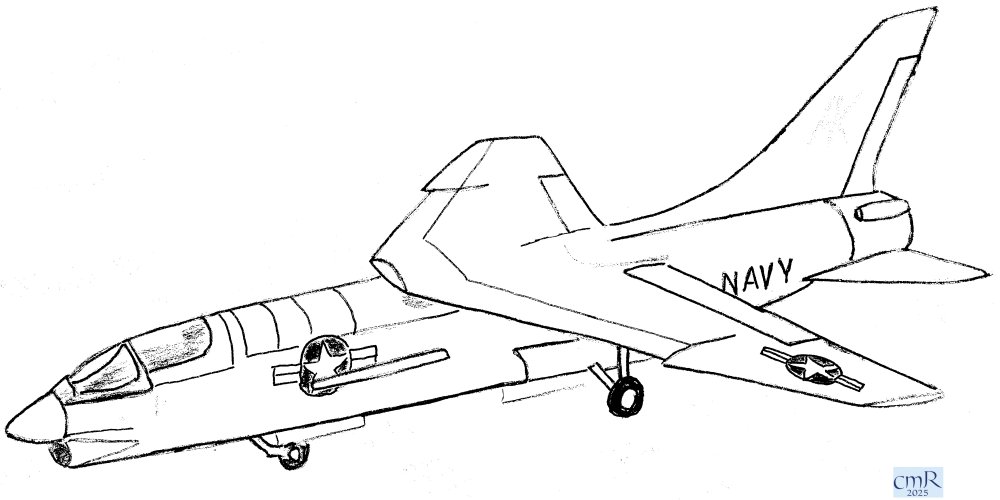
linene drawing of a Vought F8U-2 Crusader

The F4U and F7U-1 had suffered from poor pilot visibility on carrier landings, and no doubt with this in mind from the start, Vought's designers incorporated on the Crusader a two-position wing that would allow the aircraft's angle of attack to be increased without the nose having to be raised. The F8U's armament was initially comprised of a quartet of 20mm cannon and an (almost useless, and occasionally dangerous) retractable launcher on the lower fuselage for 2.75" unguided rockets.

Variants: F8U-1/F-8A: The first F8U-1s entered fleet service with VF-32 in the spring of 1957. As potent as the Crusader was, it was also something of handful, especially for pilots operating from the smaller SCB-27 ships, and losses throughout the aircraft's service life were high.

F8U-1D/DF-8A: Drone director conversions.

F8U-2/F-8C: J57-P-16 engine and ventral fin installation.

F8U-2N/F-8D: Capable of carrying four AIM-9s; J57-P-20 engine.

F8U-2NE/F-8E: Last new-build US version, with the capability of carrying underwing AGM-12s or bombs in the fighter-bomber role; J57-P-20A engine.

F-8E(FN): The only foreign customer for new-build Crusaders, and ultimately the last bastion of the type, France's Aeronavale chose the F-8 in 1963 to replace its long obsolete Aquilons. The Crusader itself was not on the cutting edge by that time, but the French needed an aircraft sized for regular operations from the Clemenceau class carriers, for which the F-4 would not be ideal. Even then, fairly extensive alterations had to be made to the F-8 to allow slower landing speeds, including BLC, increased droop for the ailerons and flaps, and larger horizontal tailplanes. By the late 1980s, the Crusader's effectiveness as a front line fighter was a thing of the past for the most part, although it was still effective in a close-in fight. Arrival of naval Rafales was still a way off, and many were advocating procurement of FA-18s as an interim measure. This was political non-starter, and the Aeronavale was forced to put 17 Crusaders through a limited upgrade program to keep them operating till the turn of the century. The resulting F-8Ps had the Sherlock RWR system (but no countermeasures fitted) rehabbed radar and electrical systems, and zero-zero ejection seats.

F-8J: Remanufactured F-8Es.

F-8K: Remanufacture of 87 F-8Cs.

F-8L: Remanufacture of 61 F-8Bs.

F-8P: 25 ex-USN F-8Hs refurbished for the Philippines; an additional ten aircraft were transferred for spares.

At War: The F-8 was involved from early on in the American combat involvement in Vietnam, with four Crusaders from the USS Ticonderoga strafing North Vietnamese torpedo boats during the first Gulf of Tonkin incident in August 1964. By the spring of the following year, US and NVAF aircraft had begun to duel, with an initial encounter between Hancock-based Crusaders and North Vietnamese MiG-17s resulting in damage to an F-8. The first Crusader victory was scored in June 1966 - the first of three MiGs that VF-211 claimed that month. In all, by 1972 Crusader pilots claimed 16 MiG-17 and three MiG-21 kills, against three aerial combat losses, although the North Vietnamese claimed 11 Crusader kills.

F8U-3: Really a completely different aircraft despite the common basic designation, the Crusader III was a significantly more powerful design, competitive with the F4H Phantom II. The -3 was powered by a P&W J75 fed through an angled intake, and a more powerful radar was fitted to guide the type's primary armament, a trio of AIM-7 Sparrows carried semi-conformally.

Advanced Projects:

Although the Crusader was well on its way out of front line US service by the early 1970s, strong vestiges of the F-8 design were still apparent in Vought's V-1100 lightweight fighter contender of the period, this being an F100 powered machine, that had it been built, would have been easily recognizable as a second generation F-8 of sorts.

F-8 Bibliography: Jim Winchester American Military Aircraft: A History of Innovation P.439: color profile of a VF-33 F8U-1E/F-8B

Ray Bonds Classic Fighters - The Inside Story p.253 F-8E cutaway diagram. Also included is a large in flight image of a group of VC-10 Crusaders, including BuNos 145549, 147029, and 147010.

Lloyd S. Jones U.S. Fighters: Army Air Force 1925 to 1980s p.325: scale F8U-2NE 3-view

Gerry Manning 1000 Preserved Military Aircraft photos p.20 F-8A BuNo 145336, F-8K/L N19TB, F-8K 145550, DF-8F 144427

Paul A. Jackson French Military Aviation photo: F-8E(FN) with wings folded

Leo Marriott Jets at Sea: Naval Aviation in Transition 1945-1955 includes a low-angle, front quarter shot of a Crusader prototype aboard USS Forrestal

Aircam Aviation Series: Sharkmouth 1945-1970 Includes photos of a YF-8A with large "NADC-Johnsville" lettering and a VF-32 F8U-1

Martin W. Bowman Fast Jet Fighters 1948-1978 p.77: photo showing a VF-194 F8U-2NE with gear down

David Gero Military Aviation Disasters - Significant Losses Since 1908 Haynes Publishing p.110-111: details and a photo of a hangar damaged in the crash of an F-8 at Miramar in 1969

Naval Fighters #16: Vought's F-8 Crusader Pt.1 Some highlights: Page of TF-8A photos; many pictures of prototypes and early aircraft; listing of MiG kills and Vietnam squadron deployments; NASA Digital FBW and Supercritical Wing aircraft; F8U-3 side view diagram & cockpit photo; F-8J/H and RF-8G 1/72 scale plans; numerous walk around detail photos, cockpit pictures and armament diagrams

F-8 Crusader in action by Jim Sullivan, Squadron/Signal Publications 1985 Some highlights: F8U-1/F-8A 3-view and specifications; Color profiles include the XF8U-1, VF-154 F8U-1, VMFA(AW)-451 F-8D, VF-11 F-8J, and a DF-8F drone director of VC-8; F8U-2NE/F-8E 3-view and specifications;F8U-3 3-view (small)

David A. Anderton "Vought's Crusader Design Meets Navy's High Performance Criteria" Aviation Week January 23, 1956 p.29 includes a photo of the XF8U-1 being towed by a tractor

Photos: "New Design Details of Chance Vought F8U" Aviation Week April 9, 1956 p.42-43

Photo: F8Us under maintenance, one with the aft fuselage removed Aviation Week December 10, 1956 p.55

"F8U stars in FIP Program" Naval Aviation News March 1957 p.22-23 7 photos VF-32 and VF(AW)-3 F8U Fleet Introduction program at Patuxent River.

Photos: "Navy Puts F8U Through Carrier Shakedown Trial" Aviation Week July 8, 1957 p.60-61

Scale F8U-1 plans Model Airplane News August 1957

Photo: in-flight view of F8U-1P with dive brake deployed Aviation Week September 23, 1957 p.27

"Crusader Squadrons join Fleet" Naval Aviation News January 1958 p.1 four pictures.

Erwin J. Bulban "F8U-1s Begin Duty on U.S.S. Saratoga" Aviation Week January 27, 1958 p.70-72+

"F8U-3 Mach 2 Fighter Makes First Flight" Aviation Week July 9, 1958 p.21

"F8U-2N in First Flight" Naval Aviation News May 1960 p.28 two pictures

"Photo Crusaders play Decisive Role" Naval Aviation News March 1963 p. 27 Five pictures. VFP-62 awarded DFCs for role in the Cuban Missile Crisis.

Photo: frontal view of an F-8E with wings folded and KD2B-1 targets loaded. Aviation Week & Space Technology April 8, 1963 p.105

Photo: VF-13 F-8 about to launch from USS Shangri-La. Naval Aviation News July 1967 p.35

"First F-8H's to NAS Miramar" Naval Aviation News December 1967 p.10

"Rejuvenated Crusader" Scale Modeler May 1974 improving the 1/48 scale Lindberg Crusader kit

"Vought F-8 Crusader Paint Schemes and Markings" Scale Modeler November 1982 Includes pictures of aircraft from VF-211, VMF(AW)-312, VC-7 F-8C, VF-194 Red Lightnings, DF-8 BuNo 143732 of VC-8, VF-51 F-8H, VFP-63 RF-8, F8U-1 of VF-103 Sluggers.

Color profiles: F8U-1 of VF-211, F8U-2N of VMF(AW)-451, RF-8G of VFP-306, TF-8A. Air International February 1985 p.94

Photo: VAH-11 Savage refueling Project Bullet RF-8s. Air International September 1987 p.123

Color photo of two Flotille 12F F-8s in flight Air International January 1988 p.12-13

Photo: Philippine AF F-8H in two-tone gray camo. Air International May 1989 p.240-241

Steve A. Evans "Crusader - Last of the Gunfighters" Scale Aviation Modeller October 2004 building the Hasegawa 1/48 F-8E as aircraft BuNo 150926 of VF-191/USS Ticonderoga

"Naval Gunfighter" Model Airplane International August 2006 Building the Academy F-8E as a VF-24 aircraft from the USS Hancock. Includes two pages of F-8E color profiles.

Model Airplane International November 2006 Preview of the Aires detail set for the Academy 1/72 F-8E kit Preview of the Aires 1/72 detail set for the Academy F-8E kit Skymodel 19/09 p.32

Warren E. Thompson "Last of the Gunfighters: F-8 MiG Killers in Vietnam" Combat Aircraft Monthly January 2016 Photos include a large shot of BuNo 150317/VF-53, 150853 and 150888.