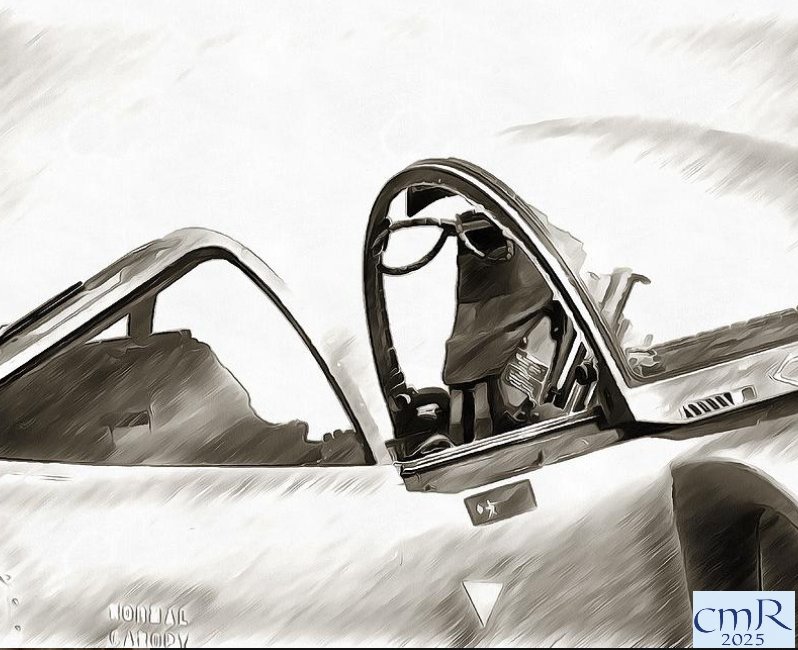
Harrier mixed media artwork. Prints available in a number of formats and sizes at:
https://fineartamerica.com/featured/harrier-christopher-reed.html
Category: Aviation
Aviation Writings and Images
F-15A Streak Eagle
F-15A Streak Eagle time-to-climb record holder on display outside of the Air Force Museum in the late 1980s. Having been stripped of its paint for the record flights, but after retirement the airframe was given a standard paint scheme (with the special markings) to protect it from the elements. After a long period of storage, Streak Eagle has since been refinished in its "bare" scheme, and is on inside display.

North American B-45 Tornado
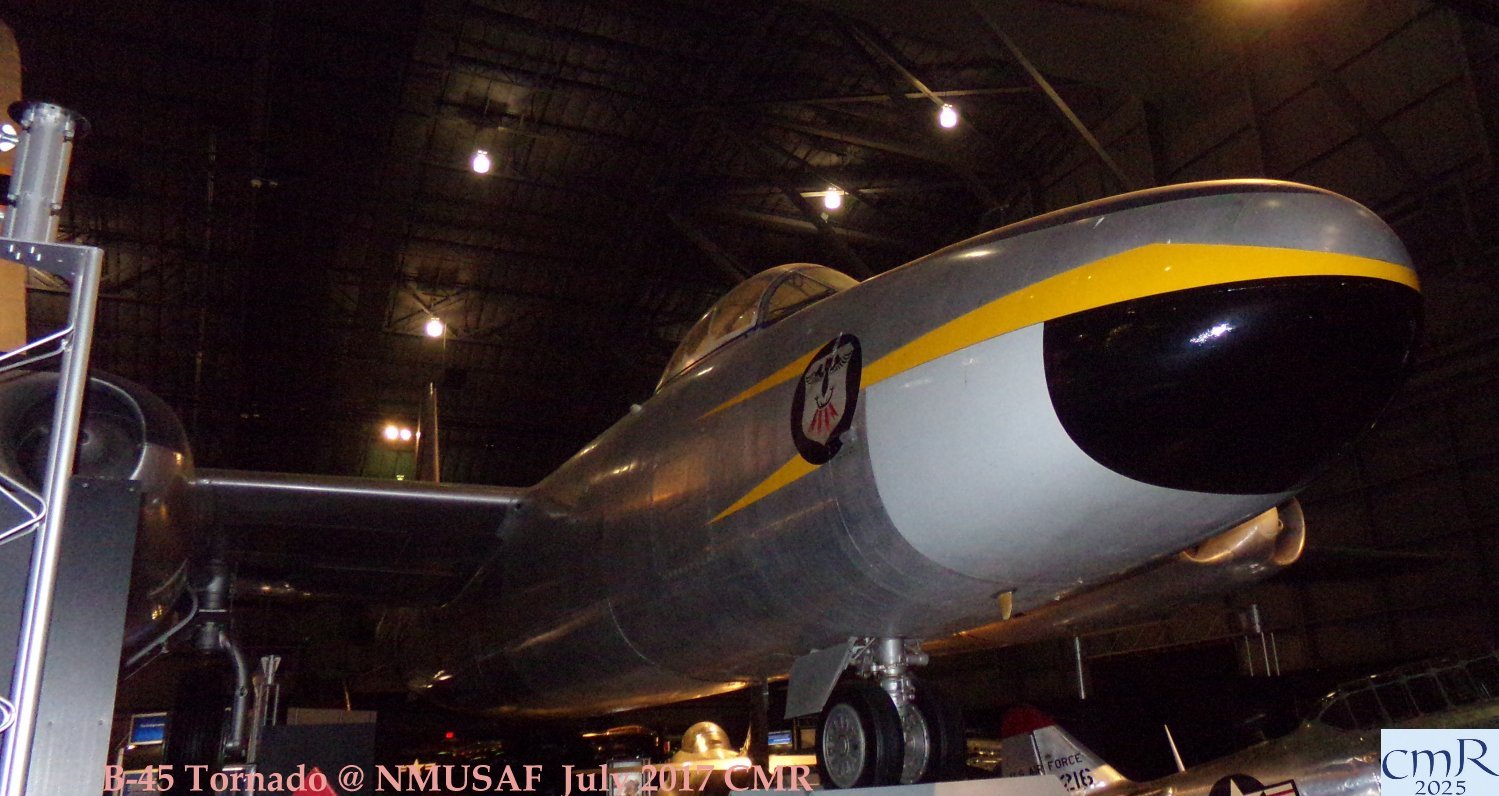
The B-45 was the first American jet bomber design to actually enter service, and although obsolete and out of service by the late 1950s, the type filled an important stopgap role in the early Cold War years, giving the USAF a tactical nuclear delivery capability in Europe for the first time, and the high-flying RB-45C recon models brought back important imagery of the USSR before the U-2 was available.
Replaced by the B-66 Destroyer, most surviving B-45s were quickly disposed of, but a new, including the NMUSAF's example, were flown as engine testbeds into the early 1970s.
F-86H Sabre at Chippewa, PA
The F-86H "Sabre Hog" was the last of the series to remain in service with the Air National Guard, the final examples not being retired until 1970, and even then some examples were transferred to Navy control for use as adversary aircraft and later drones.
Powered by a General J73 in place of the GE J47s used on earlier USAF Sabres, the F-86H also had a reinforced airframe, and the capability to carry tactical nuclear weapons. Most examples had a quartet of 20mm in place of the six .50 caliber machine guns carried by most American F-86s.
This particular airframe is preserved on a pole at the Beaver County Airport at Chippewa PA, and is seen in 2005.

F-89J Scorpion at NMUSAF
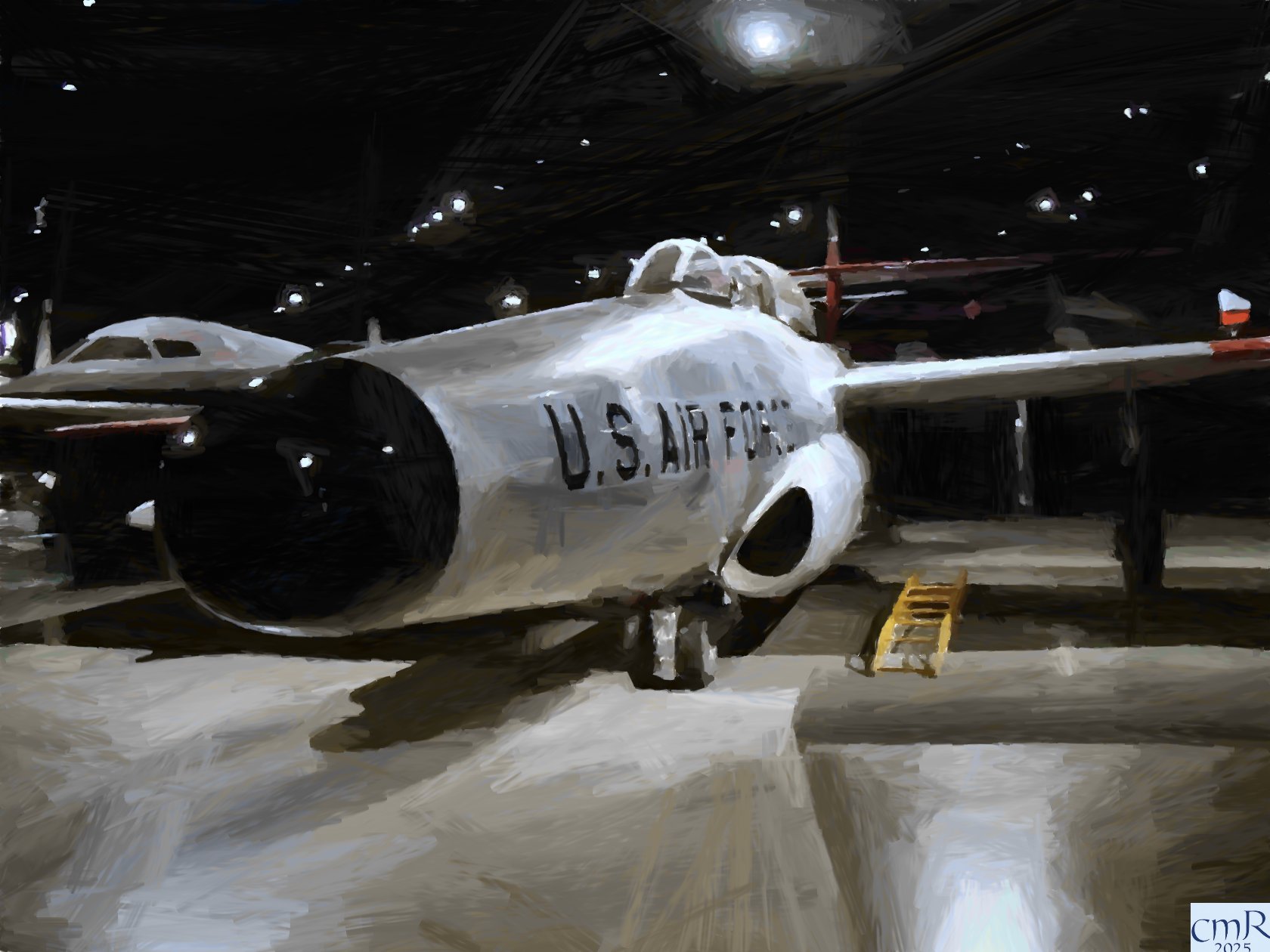
Conceived of in the immediate aftermath of WWII to replace the piston-engined P-61 Black Widow as an interceptor, Northrop's F-89 Scorpion was made obsolete as Century-series interceptors entered service, but Air National Guard units continued to operate the type until as late as 1968. The NMUSAF's missile-armed F-89J model is seen in the facility's Cold War Gallery.
P-51C "Thunderbird" walk around photos
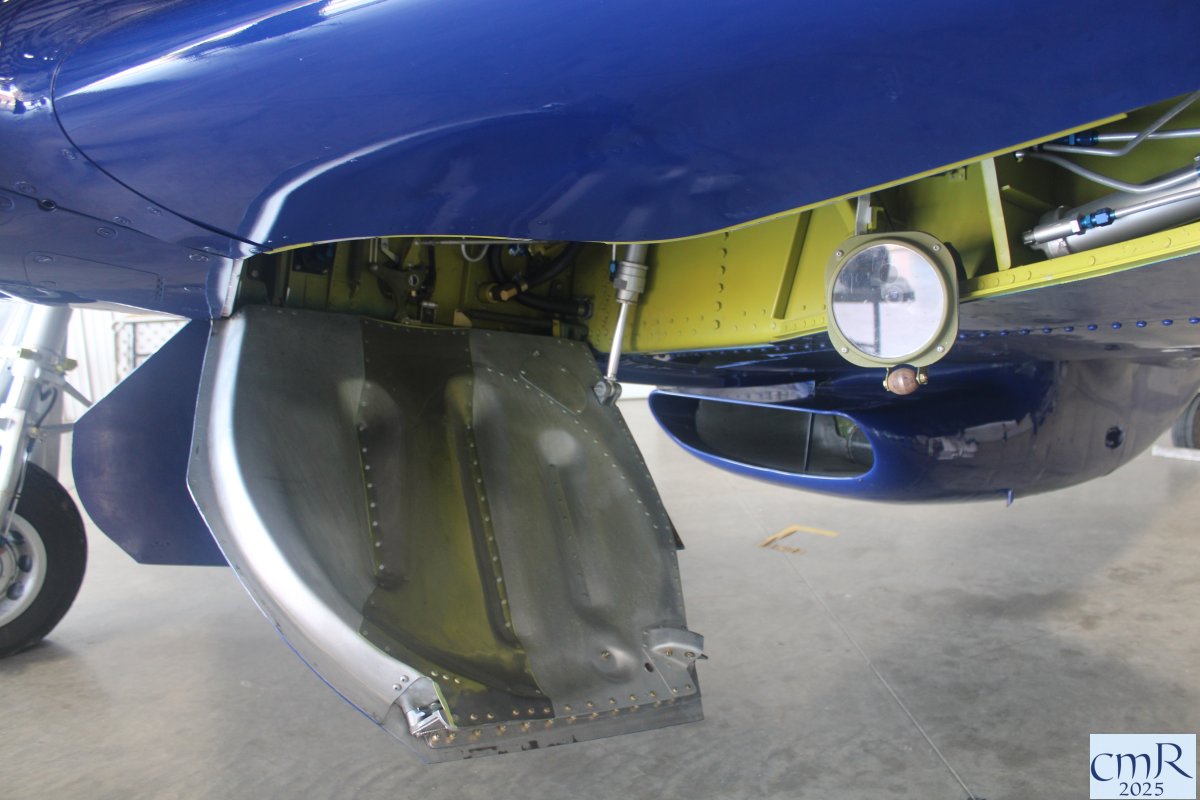
The British were the first to incorporate the Rolls-Royce Merlin engine in the Mustang airframe, with four existing aircraft being fitted with the UK powerplants as testbeds. Performance gains were remarkable, especially at higher altitudes, and in late November 1942 North American flew its own Merlin-engined XP-51B prototype. This led to the production P-51B, powered by a Packard-built Merlin, the V-1650. Just under 2,000 P-51Bs were built, these being joined by 1,750 similar P-51Cs from the North American plant at Dallas. Merlin-engined aircraft had the carburetor moved to under the nose, and the cooling intake was made deeper, with the lip set at an angle.
The P-51B also was enhanced via the installation of a third fuselage fuel tank (in the P-51B-7 variant), boosting the Mustang's internal capacity by nearly a third. This allowed an even greater range, and with external tanks the B-models could make round trips. the squadrons of the 354th FG at Boxted were the first US units to operate from the UK, and by December 194_ were escorting 8th Air Force bombers deep into the Reich. This was a pivotal development, as previously strategic targets in the heart of Germany could only be hit at night by the RAF. With long-range Mustang cover, B-17s and B-24s could hit them in daylight as well, maintaining round the clock pressure. Although the extra range was important, the additional fuselage fuel affected the Mustang's handling, and in service the tank was not filled to capacity in order to mitigate this condition.
The F-6C-NA designation was applied to 71 P-51Bs fitted for reconnaissance work.




P-51C Notes "Twelth Air Force Mustang" Scale Modeler October 1982 Building the 1/48 scale Monogram P-51B as the "lt. Blanchard" of the 52nd FG.
Photo: P-51C Princess Elizabeth of The Fighter Collection FlyPast January 1998 p.41
Cesare Pigliapoco "P-51C 'Little Bastard' Part One" Skymodel 16/08 Diorama using the Tamiya 1/48 kit as an aircraft of the Checkertail Clan.
Mario Serelle "Shangri-La - A Classic Mustang" Model Aircraft May 2016 The 1/32 P-51B from Revell.
C-133 Cargomaster art print
Douglas C-133 Cargomaster strategic airlifter
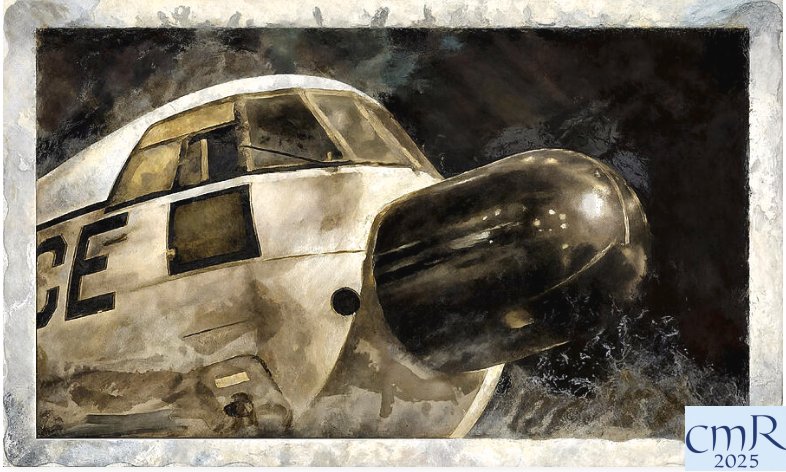 Prints at: https://fineartamerica.com/featured/c-133-cargomaster-christopher-reed.html
Vultee Vengeance
The Spanish Civil War was in many ways a proving ground for the weapons and tactics that would be used in far more vast ways all over Europe just a few years later, and dive-bombers in particular gained much attention there thanks to the exploits of the Legion Kondor. Vultee’s V-72 dive bomber was an attempt to an aircraft in the class of the Ju 87 Stuka, and the type was selected for production by the British, who in 1940 desperately needed combat aircraft.
Vultee was to build the type as the Vengeance Mk IIB for the RAF, while those license-built by Northrop would be Vengeance Mk Is. These initial orders were supplemented by US Lend-Lease supplied Mk IAs and IIIs, these receiving the US designation A-31. The US aircraft were not used operationally, although the XA-31B flew with a prototype Wasp Major engine, the XA-31B had a R-3350-18, and the five YA-31Cs tested R-3350-17s for the B-29 program.
Special Hobby has issued a 1/72 A-35B kit, with USAAF, French, RAF, and Australian marking options.
Vought / Consolidated TBU/TBY Sea Wolf
A competitor to Grumman’s Avenger, the Vought Sea Wolf was somewhat later to arrive, with the first prototype taking to the air in December 1941, by which time production TBFs were beginning to be turned out. Despite this late start, the program was still pushed, given the wartime need, and the fact that the TBU, with a more powerful R-2800 engine, was at least on paper a better performer than the Grumman aircraft. However, the program was stymied by Vought’s concentration on the F4U, and thus the whole effort ended up being transferred to Consolidated, as the TBY. It was not until the fall of 1944 that production TBY-2s began being delivered, and although there were still plans to buy large numbers, production was cancelled at war’s end after 180 had been delivered.
Sea Wolf Bibliography:
Photo: in-flight view of a TBY-2 Aviation News December 31, 1945 p.7
Paul Stockley Review of the Octopus/Pavla 1/72 TBY-2 kit Scale Aviation Modeller International April 2004
English Electric Lightning
The first true supersonic fighter of purely British origin, English Electric’s Lightning was also the last such type, as the UK subsequently turned to international projects for its fighter programs.
Variants:
F.1: First Lightning to see operational use, the F.1, like all members of the family, was short-legged and intended as a short-range interceptor, capable of rapidly climbing to meet incoming Soviet bombers. Basic armament was a pair of 30mm Adens, but a fuselage pack could carry an additional pair of cannon, or two DH Firestreak AAMs.
F.3: First of the second-generation Lightnings, the F.3 was easily distinguishable by virtue of its larger, square-topped vertical tail, which had been tested on P.1Bs. The F.3 was quite a bit more powerful than its predecessors, with Avon 301s and the more sophisticated Mk.23B AIRPASS radar. The more effective Red Top IR-guided AAM was also fitted. A pair of airframes started as F.2s were finished to the new standard, these flying in 1962, with production aircraft arriving with No.74 Squadron in the spring of 1964.
F.3A: Revised kinked leading edge that both improved high altitude maneuverability and accommodated more fuel; fixed 680-gallon ventral tank.
F.6: Last new-build version for the RAF; based on the F.3A but with the capability to carry a pair of overwing tanks. The ventral tank was later retrofitted to carry a pair of Adens, albeit at the loss of some fuel.
Advanced Proposals
As the basic P.1 was still taking shape, the RAF was looking forward to the day when speeds in excess of Mach 2 would be necessary to deal with Soviet supersonic bombers, and English Electric put forth a number of proposals under the P.6 designation to meet the ER.134T specification for a Mach 2 research aircraft, with several of these being influenced by the P.1. The P.6/1 would have mated a Lightning type tail and wings to a fuselage with a single Rolls-Royce RB.106R engine, while the P.6/2 would have a pair of Sapphire SA.7s stacked in the style of the Lightning. Neither of these were to be built, but the Lightning would again form the basis for a similar aircraft to meet the F.155T requirement for an operational, AAM-armed fighter to counter fast, high altitude threats; the P.8 would have been an enlarged single seater, powered by a pair of RB.126s.
Even into the early 1960s, developed versions of the Lightning were looked at, including a much redesigned naval version with T.5 style side by side seating, variable geometry outer wings, a solid radar nose, and lateral fuselage intakes.
Bibliography:
3-view profile: English Electric P.1A (2nd prototype) Flight 7 October 1955 p.582
Photo: P.1B XA847 in flight Aviation Week September 23, 1957 front cover
“Making the P.1 Wing” Flight 10 January 1958 Includes a two-page P.1 cutaway drawing.
Photos of F.1 XG329 and T.4 XL628 Flight 2 September 1960 p.337
Pictures (2): “Wing, Belly Tank Modified for Lightning Mk.3 AW&ST September 7, 1964 p.30
“Lightning Punch! Unsurpassed ’round the clock’ air defense for Britain” Royal Air Force Flying Review May 1961 Includes a 4-view and a colorized photo of XM140 and XM155 in flight.
Photo: T.55 55-410 for Kuwait Air Pictorial August 1968 p.276
Photo: close-in color shot of a beautiful F.6 on the strength of No.11 Squadron Meccano Magazine May 1970 front cover
Photo: Lightning T.5 XS422 of the Empire Test Pilot School. Air International October 1983 p.177
Photo: close-up of a pair of Lightnings armed with Firestreaks and Red Tops, respectively. Air International February 1987 p.76
Paul Jackson “Lament for the Lightning” Air International June 1988. A look back at the RAF’s last all-British fighter, at the twilight of its career. Includes three-views of the F. Mk.2 and Mk.6, side views of the F Mk.3, T Mk.4 and T Mk.5 trainers, and a large cutaway of the F.6.
Dennis J. Calvert “From Frontline to Warbird” Warbirds International July/August 1989. The final days of the Lightning in RAF service.
"Lightnings to fly in the USA!" FlyPast February 1998 p.11 Photo of T.5 XS422
Hugh Trevor “Lightning Cockpit” FlyPast December 1998 Restoration of XS932’s cockpit and a list of other preserved forward fuselages.
Photos: Frontal shot of T.4 XL628, P.1B XA847 with modified tail, XG310, F.2 XN723, F.3 XP697, F.3 XN725 with overwing tanks Aeroplane Monthly December 1998
“Lightning Refurbished” F.3 XR713 FlyPast January 1999 p.11
Photo: walk-around detail shots of F.1 XM135 and F.6 XS925 Scale Aviation Modeller June 1999
F.6 scale 3-view plans Aero Magazine October 2003
“Another Lightning Flies” Aeroplane October 2006 p.8 F.6 XP693/ZU-BEY
Paul Lucas “Going Grey Part 3” Airfix Model World #15 An excellent article depicting the camo schemes applied to Lightnings in the last years of their service.
Peter Johnson “Twin Tub” Airfix Model World #16 The 1/72 Lightning T.4 from Whirlykits as aircraft XM971 of 226 OCU/145 Squadron markings.
Review: Revell 1/72 Lightning F Mk 6 Scale Aviation Modeller April 2008
Review: Lightning F.2A/F.6 in 1/72 from Trumpeter Skymodel 21/09 p.66
“Lightning roll-out” FlyPast February 2012 p.6 F.6 XS897
Hans Pennick "Lightning Strikes" Airfix Model World February 2011 Building a 1/48 camouflaged Saudi F.53
Mark Davies “Small Scale Skyrocket” Military Illustrated Modeller March 2014 p.56-57 Preview of the Airfix 1/72 Lightning F.2A
John "Tigger" Wilkes "Doubling Up" Converting Trumpeter's 1/32 Lightning to a T.5 AIR Modeller 28